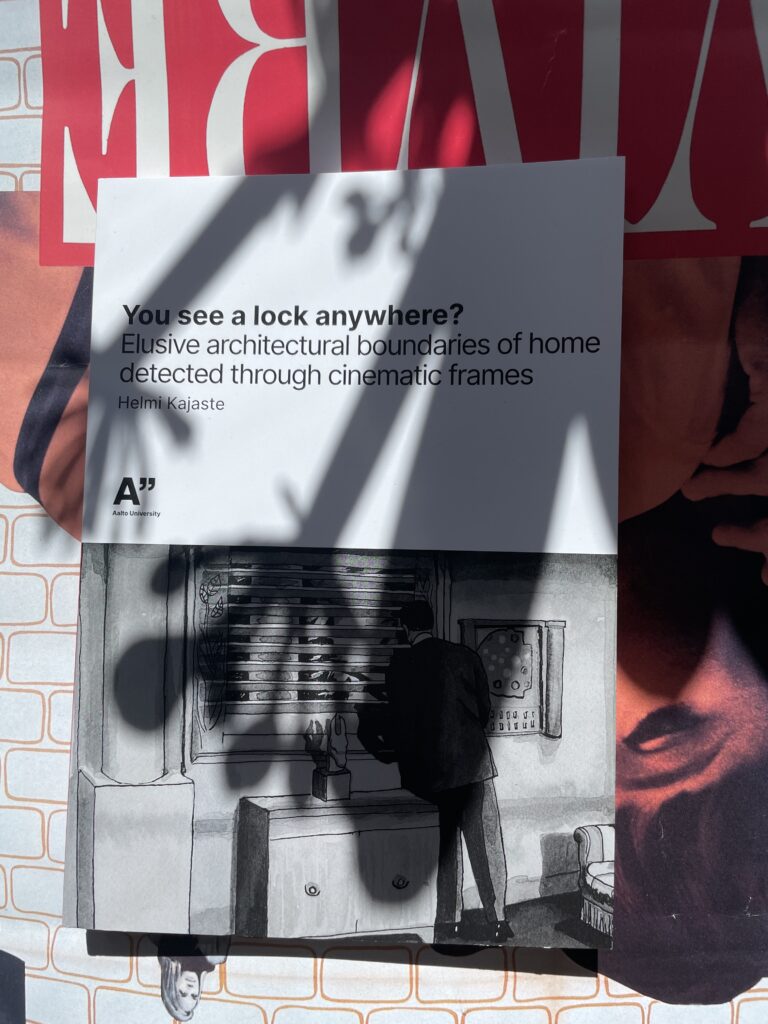
You see a lock anywhere?
– Elusive architectural boundaries of home detected through cinematic frames
Doctoral Dissertation
(Aalto University, School of Arts, Design and Architecture, 2025)
Creating boundaries can be seen as one of the main functions of architecture. Discussion about boundaries, however, is often limited to a superficial level, noting only the boundaries between, say, inside and outside or private and public – and even equating them. Every line in an architectural drawing may end up influencing social situations, and political or ideological implications may stay hidden if they are not commonly discussed.
This study delves into the functioning and meanings of architectural boundaries in human relationships. The focus is on the boundaries of the home during the period of post-World War II modernism, when widespread societal changes made it possible to rearrange people’s way of life.
To look beyond the conventions of the architectural discipline, the study approaches architectural boundaries through six fiction films: The Man Without a Past (Kaurismäki, 2002), Jeanne Dielman, 23 Quai du Commerce, 1080 Bruxelles (Akerman, 1975), Gilda ( Vidor, 1946), The Lady from Shanghai (1947), Late Spring (Ozu, 1949) and All That Heaven Allows ( Sirk, 1955) . The film analyses investigate why boundaries of home are needed, what situations follow from unreliable boundaries, and how boundaries can both provide stability and be open to change.
Through the notion of cinematic frames, the study detects how architectural boundaries influence social situations and how they can embody assumptions of dwelling and life courses. The study introduces the concept of elusive boundary to describe ambiguous spatial boundaries that can be difficult to grasp or place, but which are detectable due to their effects on people.
The film analyses show that architectural boundaries both produce and reflect spatialized longing. Moreover, the way architectural boundaries function as a measure of success in human lives becomes especially clear through the recurring characters of the widow and the widower in the case films. Housing design often assumes the family lifestyle that has been inherited from previous generations, although a misfit would be free to arrange their lives in a different way.
The study argues that architectural boundaries are far more complex than the simplified ways they are often presented in architectural discourse. Architecture can, with its temporal logic, create expectations for the future which are based on the assumptions of the past.
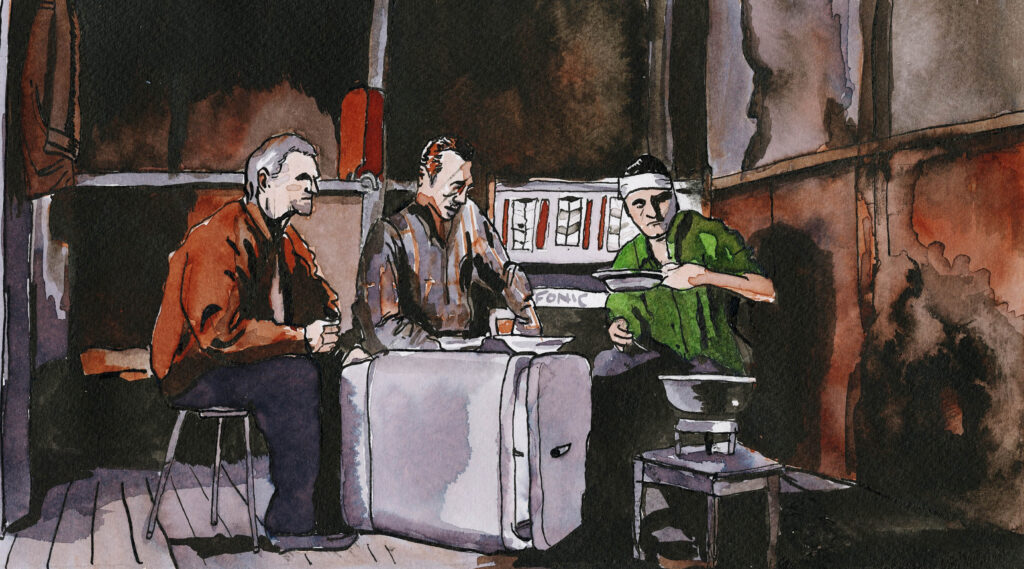
The Man Without a Past (Helmi Kajaste, 2025)